The Norman Conquest and Feudal Northumberland
After the Norman Conquest of 1066, William I and his son William Rufus tried to continue the rule of Northumberland through the earldom. It was not a successful policy. A whole succession of native and Norman earls were either murdered or led rebellions themselves, despite a punitive devastation of northern lands by William in 1080. When Eilaf the hereditary priest of Hexham went there shortly after, there was no cultivation and for two years he had to support his family by hunting. After Robert Mowbray’s rebellion in the 1090s, in which he was besieged in Bamburgh Castle, the earldom was suppressed and its lands taken by the King, who began to grant them to his followers.
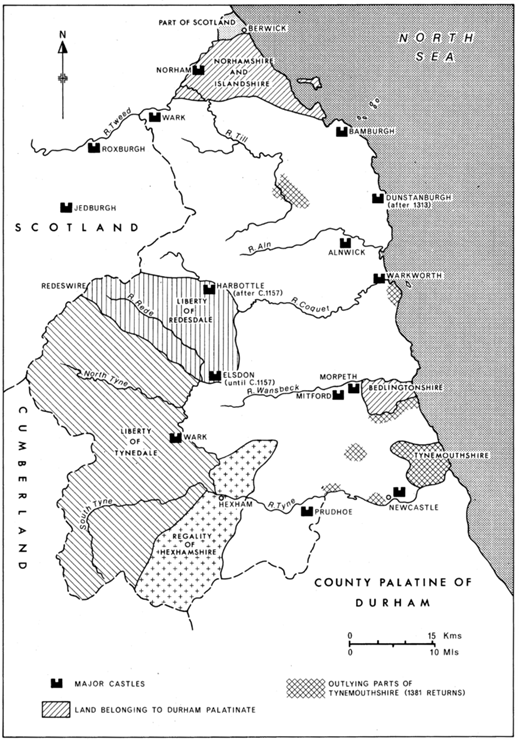
Under Henry I these grants were extensive. The Granvills got the barony of Ellingham, the de Umfravilles Prudhoe, the Muschamps Wooler, the de Vescis Ainwick. These Norman barons in turn granted parts of their estates to others, many from Norman families already settled in Yorkshire. The de Vescis, and the Tisons, to whom they granted Shilbottle, are examples. In 1166 Craster was held for a knight’s fee by Albert de Crawcestre, who probably came from the Cleveland district of Yorkshire. Many of the earliest surviving castles date from this period. The Bertrams built the motte-and-bailey castle at Mitford, initially of wood and soil, but by 1138 it had the curtain-wall that can still be seen. The Umfravilles built Elsdon, and the Bishop of Durham a castle at Norham to protect his estates by the Tweed.
Medieval Northumberland
A major problem was the expansionist Scots. In the 11th century they had invaded at any time of Norman political weakness, and after Henry I’s death in 1 135 they intervened in the civil war that followed. David of Scotland invaded through Northumberland, but was defeated at Northallerton in 1138. By the treaty of 1 139 the earldom of Northumberland was given to the heir to the Scots’ throne, who claimed it as heir to earl Waitheof, the last native earl. In 1 157 Henry II took back the earldom, later giving the dispossessed earl Tynedale as compensation, to be held as an independent regality by homage only. When William the Lion became Scots’ king in 1165 Henry refused him the earldom. William invaded in 1174, but was unable to capture Alnwick and Wark. He was captured at Ainwick, at the same time as Duncan of Fife was burning the town of Warkworth and killing the inhabitants, including those who took refuge in St. Lawrence’s church. The defeat of William the Lion gave Northumberland a century of relative peace on the border until 1296.
The Norman take-over was one of aristocratic transplantation, not large-scale immigration. In 1166 there were 21 barons and 64 knights in the county, and not all of these were Normans. W. P. Hedley, the Northumbrian genealogist, has estimated that, with all their retainers, the Normans in Northumberland totalled less than four hundred. Because Norman settlement took place some 50 years later here than further south, many more Anglo-Saxon landowners survived in Northumberland.
Under the Norman feudal system, the King granted land to barons in return for military service. The barons, in their turn, might grant part of their estates to knights, also in return for military service. In the old Anglo-Saxon system there was no such formal relation between land-holding and duties to the King or earl. Below the earl there were the thanes, who held groups of villages or ‘shires’, and the drengs, who held smaller villages or townships, and had to do more menial services for them. As Prof. Barrow notes, ‘it is probable that most of the baronies of Northumberland were created out of land previously held in thanage’. Baronies might vary greatly in size and contain different numbers of knights’ fees. In 1166 the de Vesci barony of Alnwick contained 13 knights’ fees, whereas Roger of Warkworth had sub-granted none of his barony.
A number of thanages and drengships survived, however. In 1166 there were two thanages, at Halton near Corbridge, and at Hepple in upper Coquetdale. Drengships still existed at Whittingham and Eslington, and at Mousen and Beadnell near Bamburgh, and at Throckley near Newburn. These had probably survived through relation to royal lands: the royal boroughs of Bamburgh and Newburn and a complicated assemblage of crown lands in Whittingham Vale. The services of a drengship were fairly menial: the dreng of Mousen had to pay a rent of 30s., carry 15 tree trunks a year to Bamburgh, and plough, carry and reap on the demesne lands at Bamburgh. Over the years, however, these Saxon survivals were put under pressure to conform to the Norman system. Thanes and drengs had to pay heavy taxes, notably the cornage, that knights were exempt from, and from 1159 to 1169 a sizeable cornage was demanded every other year. Gradually, the tenures were altered to knights’ fees, or, in one case, a barony.
There were also social influences. Norman names became fashionable. Before 1161, Waltheof of Hepple had been succeeded by his son William. But the Anglo-Saxon Liulfs, Waltheofs, Maidreds and Uchtreds survived a long time, especially in the lower ranks of society, and the 1296 Lay Subsidy Roll for the county lists many of them. In later years only a few Northumbrian families could trace their ancestry back to native families (notably the Gospatrics; others are the Ildertons and Roddams, but these do not date back to 1066), but this is because the early records are poor and only encompass the highest ranks of society. The vast bulk of the population was of pre-Norman origin, a mixture of Anglian, Celtic, and, to a much lesser extent, Scandinavian stock.
The actual working of the land continued to be done by this native population, whether bonds or neyfs. The latter were definitely unfree, but the status of bonds is often difficult to determine. The basic feudal services in the Norman system were an obligation to work the lord’s lands, or demesne, in return for the right to work land for yourself. In 1295 John Miller of Preston in Tynemouth held 36 acres as a bond of the prior of Tynemouth. His duties included two days’ work each week on the dernesne, ploughing, harrowing and seeding. At harvest he had to reap two days a week, bringing two other labourers with him, cart the harvest to the manorial grange, and help thresh wheat daily in the prior’s barn. He also had to take his own corn to the manorial mill. But the classic village manorial system sat uneasily on the shire-based heritage of Northumberiand, and many of the feudal duties were relics of pre-Conquest services to a mobile roual court: carting goods, food-rents and hospitality, and seasonal agricultural work, but little weekly labour on a demesne. At Shoreston in Bamburghshire the duties included carrying goods on horseback between the Coquet and the Tweed, and on the journey they were allowed bread and one drink. In 1 245 they complained that in the last seven years they had had no food on these journeys., which numbered 1,440, or over 200 a year.
The landowners were keen to retain or increase their numbers of unfree serfs, and there are many legal cases over whether a man was free or unfree. At the 1256 Assizes, Henry, the dreng of Mousen, claimed two brothers, Adam and Walter, were his fugitive serfs or neyfs. Fortunately, they were able to show that their grandfather, Walter Coltebayn, was an immigrant from Flanders, and that they were free men. William of Killingworth was less lucky, and was delivered with all his family and goods to his master, Gaifridus of Weteslade, at the same Assize. In 1292 Richard of Craster claimed a man named William as a fugitive serf, even producing William’s brother, who admitted he was unfree. William denied this, saying his grandfather was a free man who had migrated to Craster from Acklington and that his brother might also be free had he not made ‘his foolish confession’. William won, and Richard acknowledged his family’s freedom.
The whole of Northumberland was not split into military baronies. Some estates were held for official services, like the south Northumberland coronr’s lands at Nafferton and West Maften. Extensive lands were held by the church in Tynemouthshire, Hexhamshire (belonging to the archbishopric of York), and the Durham bishopric, which had estates along the Tweed and near Lindisfarne as Norham shire and Islandshire, as well as Bedlingtonshire in south-east Northumberland. Each of these were ‘liberties’ of ‘franchises’, separate from the administration of the rest of the county. The sheriff and his officers had no powers there. Tynedale was also a liberty in the hands of the Scots’ king, and Redesdale was granted to the powerful Umfraville family as a franchise.
These separate jurisdictions created problems in the administration of law and justice. This is illustrated by the case of accidental death of Adam Aydrunken (the records also have such names as Robert Pusekat, Robert Unkouth, and Richard Whirlepipyn the minstrel). In the Assize at Wark-on-Tyne in 1279 the Scots’ king’s justices recorded misadventure when Adam fell out of a boat and drowned. Normally the goods involved in a crime or unnatural death were forfeited to the King’s officers as a deodand, but in this case the jury said that the boat could not be claimed as it had drifted across to the Northumbrian bank in the King of England’s land. More seriously these liberties provided a refuge for criminals because ‘the King’s writ did not run there’. Crime was probably no greater in Northumberland than elsewhere in England, but it was less often punished. Sanctuary could also be claimed at churches, and the Scottish border was not far away. After sanctuary, the criminal was given the choice of submitting to trial or leaving the country. Tynemouth was notorious for the way the Prior was willing to take wanted men, so when William Faber of Warkworth stabbed Roger Paraventur’ in the heart with a knife, he fled to Tynemouth and was outlawed at the 1279 Northumberland Assize. In a seaport brawl Robert of Alnmouth hit William of Lothian on the head with a hatchet whilst on a ship on the river Am. William died, and Robert fled and was outlawed. The 1256 Assize Roll records the case of Roger, son of Thomas of Easingwold. Roger stole some clothes in Acklington, and, having to flee, he sought sanctuary in the church at Bolam (at that time one of the larger villages in the county). When he was seen by the coroner he opted to leave the country. The village of Acklington was reprimanded for not having given pursuit, and the village of Bolam also, for not pursuing him when the hue and cry was raised. Sometimes the criminals were not even identified: two young women, Evota and Femota, were returning from a visit to Mitford through Stobswood forest when they were attacked and robbed by ‘unknown malfactors’, and although the hue and cry was raised, the robbers got away, and the neighbouring villages were later reprimanded for not giving pursuit. The criminal who was caught could face very summary justice, even the 13th-century form of Lynch Law: William Yrrumpurs burgled a house in Wooler and stole seven skins, but the local men chased and caught him, and promptly beheaded him. When a Gilbert of Niddesdale was crossing a moor with a hermit called Semmanus of Bottelesham, he attacked the hermit, robbing him and leaving him naked and injured. However, Gilbert was arrested on suspicion by Ralph of Belford, a King’s serjeant, and taken to Ainwick. The hermit also came to Alnwick, and when Gilbert confessed, the serjeant had the hermit decapitate Gilbert, and the sheriff and coroner both later testified that this was the custom in the county.
As well as the criminal cases, the Assize Rolls contain the coroner’s records of tragic deaths. What drove Beatrix de Roddam to hang herself in the tower at Newton-on-the-Moor? The 1256 Assize Roll records that Roger of Swarland took his corn to Felton mill, but was crushed to death by two of the grinding stones. The same Roll also gives the case of Peter Graper of Colewell, who shot an arrow at a pigeon and unfortunately hit Uctred, the carpenter from Bockenfield. Uctred died, and Peter fled and was outlawed, but he later returned and was pardoned as it was an accident. The 1279 Assize records that Thomas of Hoburn was gutting fish at Seaton Delaval when with his knife he accidentally struck on the head a woman begging alms, and killed her.
The Medieval Countryside
William the Conqueror’s devastation of the north, and his incomplete hold on the region, meant Northumberland, along with other parts of the north, was not included in the great Domesday Survey of 1086. In more southerly parts of England this Survey provides a picture of the countryside at the end of the Anglo-Saxon era and before the great agricultural and commercial expansion of the 12th and 13th centuries. In Northumberland few surviving records are earlier than the 12th century (the oldest royal charter, now in Ainwick Castle, is a grant of Ellingham near Bamburgh by Henry I to Ralph de Gaugy, dated 1120-1133), and it is more difficult to disentangle the Anglo-Saxon and Norman elements in the landscape. However, the place-name evidence indicates that the main features of settlement had been laid down before the Conquest.
Nevertheless, there remained scope for considerable agricultural expansion. In the lowlands the village fields were surrounded by wastes and commons, many right down to the 18th century. There were large tracts of moor, and many areas were still wooded, as around Rothbury and Brinkburn, or in the foothills south of the Tyne. Several parts of the Cheviots were well wooded, and Robert de Umfraville had 300 acres of wood at Kingshope and 100 at Cottonshope in Upper Redesdale. There was room for the early Norman kings to set aside large areas of the county as hunting forests, as occurred around Alnwick, Rothbury, and Felton. These were not dense woodland, for the term ‘forest’ in this context comes not from the Latin foresta, but from foris, ‘outside’, meaning land outside the common law, but they were often overgrown, scrubby or lightly wooded.
In the lowlands there was open-field 4rable farming. Cultivation was generally in furlongs, often loosely grouped into blocks, and individuals might hold strips in many parts of the unfenced fields. On these plots the main crops were oats and wheat. In Northumberland the climate and soil often did not allow the roughly equal acreages of winter-sown grain, spring grain, and fallow that formed the basis of the regular three-course rotations further south. Such systems probably existed at Bamburgh and Embleton, and in 1232 there was a three-course rotation of rye and wheat, oats and fallow at Hextold. But the acreages for the Knights Templars’ estate at Temple Thornton, near Mitford, in 1308 are probably more typical: there they sowed 37 acres of wheat and 101 acres of oats. They spent £9 8s. 6d. (£9.42p) on the seed and 5s. 9d. (29p) to have the 138 acres weeded at ½d. (0.2p) an acre. The accounts also detail 12s. (60p) for the repair of ploughs and harrows, and l0d. (4p) for salt for the servants’ porridge.
The crops might be mixed up in the village fields, but the problems this created gradually forced farming towards a regular two- or three-field system for a village, each field devoted to one crop or fallow. The sort of problems are illustrated by Henry Fawkes of West Backworth, who sued the Prior of Tynemouth in 1316 for damage caused by the Prior’s animals to his corn, but the claim was disallowed because Henry had been cultivating a furlong that should have lain fallow that year.
Pastoral farming was at least as important as arable. In the Temple Thornton accounts are listed 400 sheep, though 97 had died of disease or ‘murrain’ and 3s. (15p) had been spent on sheep ointment. Two hundred and fifty-three fleeces had been sold. In many areas there were large-scale flocks and herds. During the early fourteenth century there were 3,600 sheep pastured along the lower banks of the Tweed. The Umfravilles had numerous sheep and cattle on the moors of Otterburn and Redesdale, and in 1245 the pasture of Aiwinton and Otterburn was estimated to carry 1,140 sheep and 1,400 cows. In the lowlands the animals were grazed on the commons and the fallow, but on the moorlands the sheep and cattle were taken in the summer months to the higher fells of Redesdale, Tynedale and Kidland, the shepherds living in tempprary huts or shielings, returning to the valleys in winter. As the human and animal population increased, so the regulation of pasture rights became more important. At the assizes in 1293 the Abbot of Ainwick was sued for exceeding his pasture stint on Edlingham moors. Each tenant of a bovate was allowed two horses, two oxen, two cows, two pigs, and 40 sheep, but the Abbot, who had four bovates, had overstocked to the tune of 1,000 sheep, 200 pigs, 40 oxen, 40 horses, and 40 cows.
Only rarely does the surviving evidence go beyond the manorial duties to the details of peasant living conditions in the medieval farming community. One enquiry after the death of a tenant at Wallsend in 1349 (he had died in the Black Death of that year) reported that he had farmed 23 acres, sowing 10 with wheat, two with barley, and eight with oats and peas. The man’s possessions were listed as a plough, two carts, three harrows, an earthenware pot, and a vat, four boars and a cow.
The 12th and 13th centuries were periods of great agricultural expansion in Northumberland as elsewhere in England. There was a growing population, strong Norman organisation, and an improving climate with better growing conditions. New arable land was broken in from the wastes and in some places entire new villages formed.
The expansion of existing arable can be seen at Chirton on the south of the great Shire Moor that lasted in south-east Northumberland right through to the end of the 18th century. By a deed of 1320 Henry Fawkes of Backworth granted to Tynemouth Priory, 60 acres of Rodestane Moor north of Chirton to bring into cultivation. A 1250 survey reveals even larger intakes from the commons of Shoreston and North Sunderland near Bamburgh. The bondagers of Shoreston had recently broken in 18 new acres from the moor, and bondagers at North Sunderland 312 new acres. In the south of the county at Whittonstall, Hugh de Baliol in about 1200 granted 314 acres to be assarted (cleared of trees), cultivated, built upon and enclosed. This was probably the origin of Newlands village on the Ebchester road. Later another 200 acres were added.
About a mile north of Ashington, on the Ellington road, is the site of New Moor farm. The origin of this settlement was in a marriage agreement about 1160-80, when Hugh de Morwick was granted Ashington ‘et territorium ad unam villam edificandam in Pendmor’, land to build a village in Pendmoor. Pendmoor means Penda’s swamp, and one can readily imagine the efforts to cultivate arable from the damp lands that still surround the Potland Burn today.
In the uplands the margins of farming were also being expanded, and many shielings became permanent settlements. In Tynedale, Duncliueshalch, the site of one of the hunting lodges of William the Lion in about 1166, was by 1279 the settlement of Donkleywood with arable fields. By 1292 le Carrisideschel, by the Wark Burn, was a settlement with holdings of arable and meadow, as was Shiel Dyke on Alnwick Moor north of Newton-on-the-Moor.
New settlements were also carved out of the forests. The King’s forest of Rothbury on the slopes of the Simonside hills was nibbled away by a whole series of clearings. Before 1200 the canons of Brinkburn paid the King 20 marks (a mark was 13s. 4d., or 67p), so that the 100 acres of assarts they had made in the forests might be free of all restraints, and a number of laymen also paid 16 marks for the same purpose. In 1204 Rothbury forest was granted to Robert Fitzroger, and the village of Newtown was created sometime between 1214 and 1242. By 1249 it had 270 acres of arable land. Pastureland was also important, and in 1249 the villagers of Rothbury paid 14s. (70p) a year so their animals could use the wood during the ‘fence-month’, when the wood was normally restricted to the deer. But these inroads into the hunting areas provoked landowners to create specific deer-parks to protect their game. Such parks were built at Warkworth, Acklington and Chillingham. Here in Rothbury forest, a deer park was created in 1275. Robert Fitzroger surrounded part of the forest with a stone wall, a section of which can still be seen on the slopes of the Simonsides near the small road from Lordenshaws to Tosson. Not surprisingly, the commoners reacted and at the 1279 Assize the Rothbury jurors complained that Robert had enclosed part of the forest they needed for their cattle. They added that Robert had bought off the local parson, giving him six acres as a park to stop him objecting.
The last decades of the 13th century saw the high water mark of this tide of agrarian expansion. Warfare with Scotland was about to destroy many of these gains. We, fortunately, possess a detailed tax assessment, taken in the last year of peace, 1296. This Lay Subsidy Roll is preserved in the Public Record Office. As a record it has many flaws, but it still gives, village by village, a unique assessment of relative wealth. Glendale, near the border over the Tweed, had the villages with the greatest average wealth. East and West Coquetdale, which included villages up to Lilburn and Chatton, was the second most wealthy. The heavy clay lands south of the. Coquet were much poorer with Tynemouthshire at the bottom. So Monkseaton was assessed at only £18 7s. 2d. (£18.36p), whereas Thockrington, now an isolated farm near Sweethope Lough, was assessed at £41 5s. 9d. (£41.29p), and Hethpool, west of Wooler, at £48 16s. 2d. (£48.82p).
The Anglo-Scottish Wars
The prosperity of 13th-century Northumberland was paralleled north of the border in Scotland. The royal burghs grew, trade expanded and agriculture flourished. The Southern Uplands were grazed by the sheep of the great monasteries, and their wool provided the trade for the important towns of Roxburgh and Berwick. Berwick was the greatest Scottish port, ‘a second Alexandria’, and in 1286 its customs revenue was over £2,000, compared with Newcastle’s £323 in 1282.
There were close links between Northumberland and Scotland. The border was long established, but it separated two regions with much in common. Lothian had been part of Anglian Northumbria, and the 12th century had seen extensive .Norman settlement in southern Scotland. There was much common landholding across the border: Gilbert de Umfraville, baron of Prudhoe, and holder of Redesdale, was also Earl of Angus. The Gospatric family, descendants of the old pre-Conquest Northumbrian royal house, were now Earls of Dunbar, but also held the Beanley barony in the Aln valley. The Scots’ king himself held Tynedale.
This prosperity and accord was swept away after Alexander III of Scotland died in 1286. An early fragment of Scots’ verse claimed that ‘Qwhen Alexander our kynge was dede’ then ‘our golde was changit into lede’, a backward look to a golden age that had more justice than such claims usually have. The King’s successor was a very young child, Margaret of Norway. A group of Guardians took control of Scotland, and negotiated that the girl should eventually marry Edward I’s son and heir. However, Margaret died on her way from Norway, and faced with rivals for the throne the Scots reluctantly allowed Edward to arbitrate. This he did, at the price of recognition of his overlordship of Scotland, and he decided in favour of John Balliol, who did homage to Edward.
As late as Michaelmas 1295 there was still peace on the border, and Ellen de Prenderlath, a Scotswoman, invested a legacy in a mortgage secured by a lease on Moneylaws, just on the English side of the Tweed. The Scots, however, had had enough of Edward I’s claims to overlordship. In Berwick, English ships were burnt and merchants killed, and a group took Wark Castle. Edward rapidly recaptured Wark and besieged Berwick, which he took with great ferocity, slaughtering many of the inhabitants. In a counter-move the same month, April 1296, a party of Scots, aided by Adam Swynburne of East Swynburne in Tynedale, raided across the Cheviots, burning villages and crops, damaging Hexham Priory, and, according to English propaganda that was probably a gross exaggeration or distortion, burning alive 200 schoolboys at Corbridge school.
This outbreak of war was to lead to 300 years of trouble and poverty along the border. Many landowners were torn in their loyalties, and several Northumbrians like Swynburne, Wishart of Moneylaws, and Ros of Wark sided with the Scots. Although William Wallace, a leader, of the Scottish independence revolt, wasted much of the county in 1297 from a base in Rochbury forest (but was unsuccessful in besieging the castles) , Edward I was largely victorious and carried the war into Scotland. But after Edward’s death in 1307, Robert Bruce’s campaign of ‘defending himself with the longest stick he had’ led to raids in Northumberland. In 1308 the crops at Temple Thornton near Nether witton had been ‘sold in a hurry through dread of a raid of the Scots’. The Community of Northumberland paid Bruce £2,000 in blackmail for truces in 1311 and 1312-13. Cattle and sheep were driven off, crops taken or destroyed. The discord of Edward II and his barons led to weak resistance; some, like Thomas of Lancaster, had dealings with Bruce.
After his defeat at Bannockburn in 1314, Edward still refused to recognise Scottish independence, so Bruce ran an intensified terror campaign in the north of England, penetrating as far as north Yorkshire. There was great devastation, but because it was remote from the heartland of southern England, Edward was slow to react. The record for Tarset in Redesdale in 1315 that ‘the manor is now worth nothing because it lies waste and destroyed by the Scots’ is repeated in village after village. The coalmines at Cullercoats were destroyed. Law and order collapsed, and the people were torn between the Scots and local oppressors like Jack le Irroys. In 1316 the inhabitants of Bamburgh complained that this constable of Bamburgh Castle refused to let them buy off Bruce for £270 unless they paid him an equal amount. There were many petitions for war damage, and in 1318 Edward ordered the distribution of 40 tuns of wine to deserving members of the Northumbrian gentry.
The disasters of these years were compounded by a wet summer and ruined harvest in 1315, and great famine the following year. In desperation at Edward’s lack of protection for the county, a group of Northumbrian knights and gentry led by Sir Gilbert de Middleton rebelled in 1317, in alliance with the Scots and possibly with Lancaster.
They kidnapped the Bishop-elect of Durham and two cardinals, and held Mitford and Horton Castles. The rebels were defeated, but, although they have often been pictured as mere bandits, the revolt was partly a response to the breakdown of law and order, and their action is understandable. Many Northumbrians changed sides at this time.
The English continued to refuse to agree to a treaty, and in 1327 Bruce led a further series of devasting raids. This time he may have planned to annex Northumberland, for he granted land charters to his followers, such as part of Belford to a member of the Scrymgeour family. The ‘poure gentz de la Communaute de Northumbreland’ petitioned Edward for pardon of war-time debts as 200 townships lay deserted. This time Edward did agree to a treaty, but with Bruce’s death shortly after, Balliol renewed his claims, and there was a drift into regular war again.
It would serve no useful purpose to recount the detailed sequence of battles, raids and truces over the period 1330 to 1490. It is unlikely the devastation was ever as great as that in the period of Bruce’s terror campaign, though that was, of course the period when there was still something to lose. The 1330s saw the war carried into Scotland and the establishment of an English-controlled buffer region in south-east Scotland. But raids continued, and in 1346 David Bruce ravaged around Slaley and Blanchiand before being defeated at Neville’s Cross. After a truce of eight years there was war again in 1355, when Sir Thomas Gray was captured at the siege of Norham and imprisoned in Edinburgh, where he began his great chronicle of the border war, Scalachronica.
Another disaster magnified the tragedy of 14th-century Northumberland. In 1349 the Black Death or plague struck with even worse effect than the Scots. Many died, and the local economy was disrupted: at Monkseaton in the south-east, the bondage holdings were reduced by one-third, and as late as 1377 six of the other 10 farms had lain waste ‘since the time of the first pestilence’. At Belford there were so many dead the gentry had to ask for a local cemetery as Bamburgh was too distant.
One aspect of the years 1330 to 1400 is particularly important: a change in the power structure in the county. Many of the older families were ruined by the Scots’ raids or by confiscation following their choosing the wrong side at the wrong time. Power and influence increasingly went to holders of military and Crown office, with their incomes, military backing and acquisition of forfeited lands. Foremost were the Percies, an old-established family in Sussex and Yorkshire, but who had only acquired the Ainwick barony in 1309 from Bishop Bek. In 1331 they got Warkworth barony, and made Warkworth Castle their main home, and later acquired the Prudhoe barony from the Umfravilles, who largely retreated into their Lincolnshire lands. During the 14th century the Percies (who became Earls of Northumberland), along with the Nevilles, rose to be the main military and political leaders in the north, serving as Wardens of the Marches. A host of lesser men also rose in status through the wars, and this was highly resented by the older families, in one case at least leading to murder. John Coupland was a local man who had risen in the royal service, especially after capturing David Bruce at Neville’s Cross. He was made a banneret with a £500 annuity and was several times sheriff of the county. (It is interesting to note that one of his fellow sheriffs in the 1350s was Alan del Strother, who was probably one of the two clerks celebrated in Chaucer’s Reeve’s Tale.) Coupland was murdered on Bolton Moor near Ainwick just before Christmas in 1363 by a group of Northumbrian gentry, a murder that was covered up by the investigating jury, not surprisingly since the jury contained Sir William Heron, one of the instigators of the murder.
The new men had come to say, however. Border warfare became institutionalised, with local leaders having a vested interest in its continuation, and in raiding and plunder. Even during formal truces there were private raids by both sides, often instigated by the great barons themselves. On the Scottish side the Douglases filled the role of the Percies and there was great rivalry between the families, culminating in the Scots’ raid on Durham in 1388, the subsequent personal combat between Harry Hotspur and Douglas before the Walls of Newcastle, and the Scottish victory (but Douglas’s death) at the battle of Otterburn. In 1402 the Percies got their revenge at the battle of Homildon Hill near Wooler. The power acquired by these great border magnates through their standing armies grew to be a threat to both the English and Scottish kings. The power of Percy and Neville put Bolinbroke on the throne in 1399, and these families were heavily involved in the English political conflicts of the 15th century. For a short period from 1461 to 1464 Northumberland was the focus of the Wars of the Roses, with Edward IV defeating the Lancastrians at Percy’s Cross and Hexham, and besieging Bamburgh and Dunstanburgh. These conflicts, combined with internal political problems in Scotland, meant that there was less organised border warfare than in the 14th century. But this did not relieve the poverty or halt the intermittent fighting and raiding. So in 1416 Hepple in Coquetdale was destroyed by the Scots, and again in 1436, and in the late 1440s the Douglases burnt Alnwick and Warkworth. The future Pope, Aeneas Sylvius Piccolomini, travelled through Northumberland in 1435 and recorded a bleak picture. The houses were of earth or wood, white bread was unknown, and at night all the men took shelter from the Scots in a local pele-tower, but left the women outside, saying that they would not be harmed. Aeneas was glad to reach Newcastle and commented ‘Northumberland was uninhabitable, horrible, uncultivated’.
Churches and Monasteries
In 1074, eight years after the Norman Conquest, three monks arrived at the banks of the Tyne, and a revival of monasticism in the North began. They were Aidwin, a monk from Winchcombe in Gloucëstershire, with two companions from the Evesham monastery, and they had travelled on foot with a donkey to carry their vestments and books. They found the old monastery at Tynemouth to be uninhabitable, and were persuaded by the Bishop of Durham to settle at Jarrow.
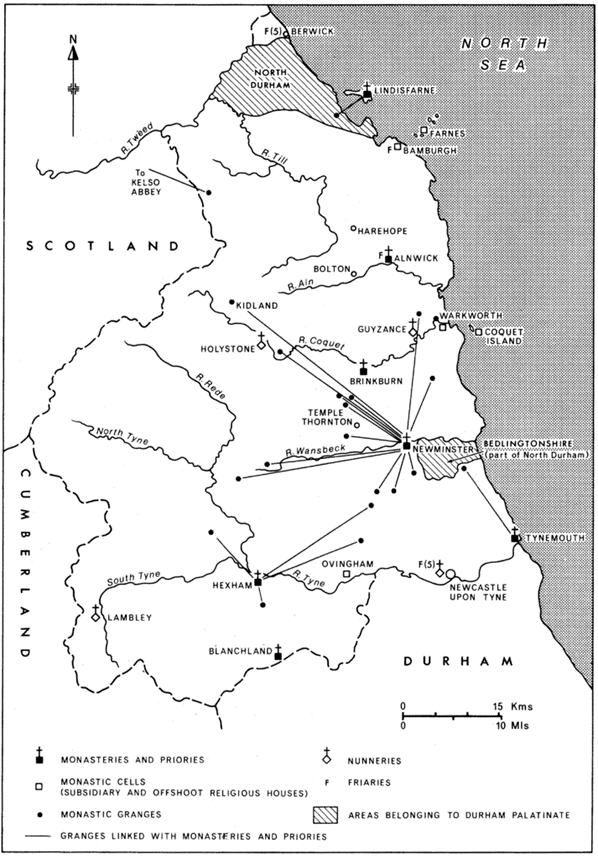
In the succeeding years, other monastic communities were established: at Lindisfarne in 1082, as a cell of Durham; at Tynemouth in 1083; the Augustinians at Hexham in 1113, and at Brinkburn on the Coquet in 1135; the Cistercian order at Newminster in 1139, and the Premonstratensians at Alnwick in 1147, and Blanchland, on the Durham border, in 1165. Nunneries were set up at Holystone, during the reign of Alexander I of Scotland (1107-1124), and at Guyzance before 1 147. There was also a major rebuilding of churches. One of the finest and most complete is St. Lawrence’s at Warkworth, built on the site of an earlier Anglo-Saxon church.
Monastic Northumberland
The foundation of the monasteries was only made possible because of large grants of land and money by the Norman nobility, and many of the monks were themselves men of rank and wealth. Brinkburn, for example, was established by William Bertram of Mitford, who gave the abbey large grants of land in mid-Coquetdale. Ralph de Gaugy, baron of Ellingham, gave the convent of Durham the endowment of Ellingham church, and this charter has survived intact. These grants established the monasteries as major landowners and economic forces. In addition, there were many smaller gifts: amongst hundreds of grants, Brinkburn received the wood on Rimside moor, a marl-pit at Weldon, a marsh below the spring in Old Felton, licence to buy and sell in Alnwick, a shop in Corbridge, and a saltpan in Warkworth.
The Church grew to wield great political power. In the North-east the Bishopric of Durham was very powerful, especially under Bishops like Antony Bek (Bishop 1283-1311) and Thomas Langley (1406-1437), both of whom were high officials of the King. At the beginning of the Scottish troubles, Bishop Bek, a close adviser of Edward I, acquired control of Tynedale, Penrith in Cumberland, the Isle of Man, the Vesci barony of Ainwick and its related estates, and the barony of Langley in Allendale. These lands, together with the traditional Bishopric lands in Durham and Northumberland, created a virtual cordon across the North. Bek, however, fell foul of his patron, and the new acquisitions were either confiscated or sold off.
The increasing wealth and political power of the Church caused many to consider the Church was being corrupted from Christ’s teaching, and from this belief arose the various orders of friars, vowed to live in poverty and to help the poor. They lived mainly in the towns. The Carmelites founded friaries at Hulne (Alnwick) in 1242, and at Berwick and Newcastle. The Dominicans settled at Bamburgh and Newcastle, and the Franciscans at Berwick and Newcastle. Over the years these groups also tended to acquire wealth. Hospitals were also established, some as hostels for travellers. At Bolton, near Edlingham, Robert de Ros founded a leper hospital in 1225 for a master, three chaplains and 13 lepers, and at nearby Harehope another leper hospital, run by the order of St. Lazarus, was started in 1247.
The monasteries were major contributors to the medieval expansion of cultivation and land use. The Cistercians of Newminster, as was typical of their order, were particularly active in this, running outlying farms or granges right across mid-Northumberland from Sturton Grange on Warkworth Moor to Wreighill in upper Coquetdale. They brought extensive upland areas into use as sheep-grazing, particularly in Kidland and Cheviot. They first got a lease of Kidland from Odinell de Umfraville in 1181, though he kept his hunting rights and insisted that the monks’ dogs had one foot cut off to prevent their chasing the game. By 1 270 the abbey was able to sell Jehan Boinebroke 72 sacks of its own wool and 20 sacks of collected wool, which add up to at least 18,000 fleeces. Other monasteries, such as Tynemouth and Lindisfarne, also had granges for pasture or grain-production. On Lindisfarne the Prior’s accounts reveal the careful farming. The oxen were muzzled as they led the corn from the harvested field, in case the animals should chew the bound sheaves. Women were hired to weed the thistles from the wheat fields, and these thitles, after softening in the sun, then provided fodder for the horses. The expanding margin of cultivation can be seen in numerous examples: about 1225 Roger Bertram gave the Holystone nuns his wood of Baldwineswood, which they ‘ridded’ or assarted, creating Nunriding, west of Mitford, still held by the nuns at the Dissolution of the monasteries and rented out at £1 6s. 8d. (£1.33p) a year. In 1234 the brethren of Bolton hospital got a grant to enclose the 120 acres they had broken in from the moor and the 150 acres they had cleared from wood.
The disasters of the 14th century seriously affected the religious houses. The Scottish Wars took their toll, both on the lands and income of the monasteries and churches, and also on life and limb in frontier areas. The nunnery of Holystone, high up in the lower folds of the Cheviots, had to be abandoned during the summer raids of the Scots in 1322, and in August Edward II, as he passed through Newcastle, gave alms to the nuns who had fled there. Ten years later the nuns were granted 10 quarters of wheat from the royal stores at Newcastle because their corn and granges had been burnt. and their cattle driven off by the Scots. The Black Death of 1349 also struck communal institutions hard, and many smaller foundations became extinct during the century. The nunnery of Guyzance is not heard of after 1313.
The religious life never fully recovered from these disasters. Numbers fell: Holystone had 27 nuns in 1313, but only eight in 1432. Society became less well disposed towards them, and gifts declined during the 15th century. Tynemouth received no lands after 1404. The small legacies to all the religious houses in the North-east given in Roger Thornton’s will in 1429, which brought Holystone one fother of lead, were amongst the last of their type. The worldly preoccupation of the religious houses became more obvious: the major priors and abbots were border lords, and the abbeys regarded as sources of food and supplies by the military and political leaders.
The decline continued in the first half of the 16th century. At Alnwick there were 25 canons in 1500, but only 17 on the pension list after the Dissolution. At Blanchiand at the beginning of the century, the abbot could not even find a barber and washerwoman for the community. Henry VIII’s decision to suppress the monasteries did not therefore destroy a thriving institution. In 1536 his Commissioners dissolved all houses with less than £200 income, and in 1538 and 1539 the larger monasteries. After the first suppressions, there were desperate attempts by the larger houses to prolong their lives. At Tynemouth they tried to get the support of influential landowners by granting them long leases on monastic lands: in September 1536 Thomas Lawson of Cramlington was granted a 41-year lease on Hartford, and in October Robert Collingwood got a 61-year lease of Bewick. But it was to no avail.
The only attempts at resistance were at Newminster (where a mob from Morpeth razed the abbey to the ground) and Hexham. Although its income was slightly over £200 Hexham was included in the 1536 suppressions, but the canons refused to open the gates and when the Commissioners arrived in September, the Master of the cell of Ovingham appeared above the gateway in armour. The canons were encouraged by some of the local gentry, and the resistance became a very minor part of the Pilgrimage of Grace, a general revolt by northern leaders against not just religious reform, but also the growing centralisation of power in royal hands. When the movement collapsed (in Northumberland it had been mainly an occasion for inter-family feuding), the canons ceased their resistance.
The impact of the Dissolution was felt in several ways. Effects on the land market are explored later. The religious were dispossessed. It is important to get their numbers in proportion. Despite the vast estates they controlled, the total number of religious in Northumberland and Newcastle affected was only about 230 people. These were pensioned and most were absorbed into the parish church system. Some, such as the Premonstratensians at Alnwick, had already been sending monks into parishes for some time. After 1538 William Hudson became master of Ainwick grammar school, Robert Blake was a chantry priest at St. Nicholas’, Newcastle, and Robert Forster a curate at Alnmouth. The former prior of Tynemouth, Robert Blakeney, farmed his manor of Benwell, and John Gray of the Austin friars at Newcastle became vicar of Chillingham. The nuns, mostly from wealthy families, ‘returned to them. In the case of Agnes Lawson, prioress of the Benedictine nunnery in Newcastle, her family bought up the nunnery and lands.
Medieval Merchants, Towns and Trade
The agrarian expansion of medieval Northumberland was accompanied by a parallel growth in both regional exports and internal trade. The county’s grain produce was mainly for local consumption, and the main exports came from pastoral activity: the hides of cattle and the wool of sheep. In medieval England such trade. was not carried on in a free market, but was strictly regulated: rights to sell and trade were monopolies and privileges granted by royal and baronial charters, usually in return for higher rents and taxes. At least as early as the mid-12th century Newcastle established its rights for the export of hides, wool and woolfells (wool on the skin) from the region. The internal history of the town and its charters will be studied in Chapter X. In accounts for about 1290, Newcastle headed the list of English ports for the export of leather. At this time the export of wool was growing in importance, and Edward I’s decision to raise money by customs dues on wool and hides meant detailed records of many of these exports were kept and have survived. Northern wool was coarse and of poor quality compared with the best English fleeces. In 1337 it sold at five marks a sack (about 26 stones), against Herefordshire’s 12 marks and Shropshire’s ten. But although it had to pay customs dues at the same rate, it was still a profitable export. In the early 14th century Newcastle ranked sixth in English wool exports. There had been a notable expansion during Edward’s reign: for Easter 1292-93, Newcastle exported 841 sacks of wool, 8,042 woolfells and 55 lasts of hides (a last was 200 hides). By 1304-5 the trade was 1910 sacks of wool and 35,000 woolfells.
Medieval Towns and Markets
From the customs accounts we can see the details of the trade. Plate 13 shows the customs entry for the sailing of John Prest’s ship the Backebrad on 20 April 1297. The captain took some wool on his own account, but his cargo included about 20 sacks for Peter Sampson (line 2), eight for Richard of Embleton, and eight for Walter of Cowgate. The main destinations at this time were the clothmakers of Flanders. Already the exporting and shipping businesses were becoming separate, and many of the ships were foreign. In a seven-year period, out of 205 sailings from Newcastle, 170 were sailings of 162 foreign ships, the vast majority making a single journey. Twenty-two came from Middleburg, 17 from Calais, 13 from St. Valery, and 12 from Barfleur, though a few single sailings went to northerly ports like Groningen and Lubeck. The ships themselves were mostly very small, less than 100 tons, and smaller than North Sea drifters. The export trade itself was largely in English and local hands. Out of 216 merchants who traded through Newcastle in the same seven years, 138 were foreign (mainly from Flanders), but they made mostly small, single shipments. Seven belonged to the Italian trading societies, and these ran larger shipments, such as James Glare of Florence, who exported 871/2 sacks between 1287 and 1293 for the Society of the White Circles, and Villan Iscoldi, representative of the Black Circles, exported 52 sacks in 1297. The bulk was handled, however, by the English merchants, especially the 50 based in Newcastle.
In the 1296 Subsidy we can identify the major traders. The richest individual was Samson le Cutiller, assessed at £53 14s. 4.s. (53.72p), who paid more tax than whole groups of villages in the county. (By comparison, Sir Richard Craster, a typical county knight, was assessed at X10 45. 8d. [XIO.23p].) Hugh Gerardin and Isolda de Pampeden (Pandon) were jointly assessed at £84 in St. Nicholas’s parish. Gerardin shipped 110 sacks and 520 woolfells in 1293-96. Other important merchants were Peter Graper, exporting 103 sacks in 1292-97, Peter Sampson with 77 sacks in the 1290s, and Adam of Hoga who was based in Wooler. In 1308 Richard of Embleton was personally responsible for an eighth of the town’s exports.
If customs were paid at Newcastle, the wool could actually be shipped from another northern port. In July 1 292 James Clare paid dues on 16 sacks of wool, which were carted at Alnwick. three days later and shipped from Berwick. The proximity of the Scottish border encouraged smuggling. The Scottish port of Berwick had lower dues, and when it was in English hands in 1340 Newcastle burgesses complained that Northumbrian wool was being sent north to pay only half a mark a sack, instead of three at Newcastle. Smuggling was also encouraged by the staple port system which was introduced in 1313 to ease customs collections. All wool exports had to be channelled through certain ports, sometimes a group of home ports, sometimes Continental ports. Newcastle often got exemption from the system, but whenever exports were forced to go through a port like Calais, Newcastle’s trade (which was mainly with markets further north) became much more costly. Many prominent merchants smuggled, even the customs officers. In 1341-42 William de Acton was fined 200 marks for exporting 14 sacks of uncustomed wool, and John of Denton 250 marks, and in 1364 a group chartered the Katherine to take coal from Newcastle, but in fact loaded it with 16 sacks of wool and 600 woolfells for uncustomed export to Zeeland.
The Scottish wars had a major influence on trade. The hide and wool trades were disrupted, shipping became more hazardous, and special taxes were demanded to fund the war. But war-contracts could also be lucrative for some merchants, and in 1332 John of Denton provided 393 quarters of wheat, 202 of oats, and 22 tuns of wine for the King’s forces. Although wool remained the major export, Newcastle merchants exploited commodities found in the immediate vicinity, and so less liable to disruption. Grindstones from the Gateshead Fells were a standard export down to the 18th century, giving rise to the 17th-century saying that ‘three things were to be found the world over—a Scot, a rat, and a Newcastle grindstone’. Coal from local mines became a significant trade commodity (see Chapter XIII), though it was not dominant until the 16th century. Atrade balance for 1508-9 constructed by I. S. W. Blanchard values the coal trade at £225, but wool at £498. Lead exports, mainly from Weardale, had grown to £267 worth.
The medieval trading pattern ended in the early 16th century, with the collapse of the cloth-trade in the West Brabant towns, Newcastle’s main wool market, in the 1520s. Home cloth production in England was also taking much of the wool. In its place came the coal trade, and also an expansion of the Baltic or Eastland trade. Newcastle had a long history of trade with the Baltic, but for a long time it had been mainly carried in ships of the Hanseatic league of cities, who excluded English ships from the Baltic. In the 1390s there had been a brief English breakthrough, and in 1394 the cargo and crew of the Good Year, owned by Roger Thornton and others of Newcastle, were seized by the Hanseatic towns of Wismar and Rostock in a dispute over customs dues. The cargo of cloth and wine was valued at 200 marks. In the 16th century the Danish Sound was re-opened to English ships and, in 1537, 52 Newcastle ships entered the Baltic.
The Tyne’s imports were much more diversified than the exports. In 1336 Richard Galloway, Robert de Shilvington and Adam Tredflour loaded the Petit Cuthbert of Newcastle at St. Valery-sur-Somme in France with cob-nuts, herring, cockles, ‘blandurer’ apples, woad, a carpet and a coverlet. From the Baltic came wooden boards, furs and corn. Wine imports, especially for Durham Priory, were important, and merchants like Robert de Castro acted as the Prior’s agents.
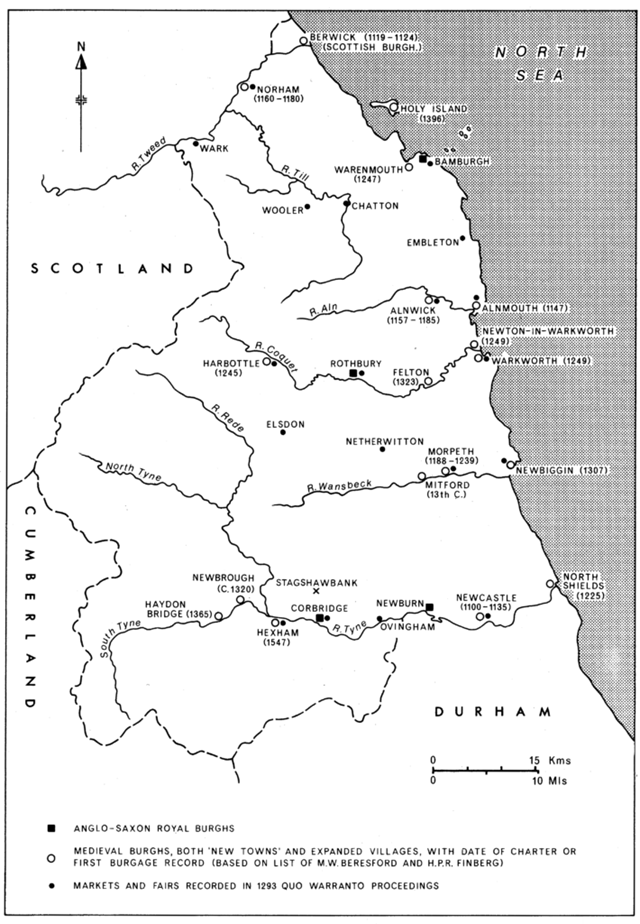
Behind the regional exports and imports lay a network of internal trade and markets. Newcastle again dominated the scene, but at a local level there were many regular markets and fairs spread across the county, each usually based on a baronial administrative centre. So in 1257 Henry III confirmed to Roger de Merlay a Friday market at Netherwitton and a yearly fair of eight days on the eve, during and six days after St. Lawrence’s Day (10 August), unless the market or fair were ‘hurtful to neighbouring markets and fairs’. At the markets tolls were charged on many of the commodities, enabling us to identify the significant items. Grain was sold at most markets. Exotic groceries like pepper, cinnamon, almonds and figs appear in the accounts at Berwick, Newbiggin and Newcastle. Corbridge was the centre for ironware, selling horse-shoes by the thousand and nails by the two thousand. It also held the great cattle fair on Stagshawbank on Old Midsummer day (24 June). The record of an interesting transaction here in 1298 has survived. Robert of Hepple and John of Ireland bought up 72 oxen, ironware and wagons, probably to supply Edward I’s army, but they purchased around the fair in small lots through many different agents so that news should not get out that there was a single big purchase on.
Between these regular markets and the great regional centre of Newcastle were a number of urban centres or burghs, distinguished from the surrounding countryside by their special rights and tenures. Like Newcastle, these centres gained or were granted privileges (e.g., freedom from market tolls and from labour services) by the King or local barons in return for taxes and rents. The old Anglo-Saxon burghs had been purely administrative centres, and several were in decline by the 13th century: Newburn is last heard of as a burgh in 1201, and in 1296 Rothbury was taxed at the rural rate. Corbridge, however, was the second town in Northumberland, with a population of about 1,500 people. Just as the agrarian expansion saw the creation of new villages in the Northumbrian landscape, so the commercial expansion led to the creation of ‘new towns’ and the planned expansion of old settlements. The incentive for the King or feudal lord was the increased rents from burgage property, tolls on market sales to outsiders, the presence of local craftsmen and general improvement of his estate. The King also charged higher taxes on borough wealth: in the 1296 Subsidy villagers paid one-eleventh of their assessed wealth, but burgesses paid one-seventh. Many of these local trading monopolies lasted a long time. Ainwick got a charter in 1157-85, and as late as 1 735 the Merchants’ Company of Ainwick voted that ‘John Boulton of Warkworth be proceeded against for frequenting Alnwick market and selling lint’. At Morpeth a charter of the de Merlays gave Newminster monastery a piece of land ‘ad capud novae villae de Morpath quam fundavi’, ‘to the top of the new town of Morpeth which I founded’. Hexham was expanded as centre of the York archbishopric’s lands in the county. At Warkworth the main burgh, like others at Norham and elsewhere, was probably not intended as an urban centre, but rather as a rural settlement with more tenurial and personal freedom than the normal countryside, in return for providing craftsmen and services for the baronial centre.
The difficulties of medieval road travel meant coastal trade was important and several of the new burghs were ports. At Warenmouth, near Bamburgh, William Heron got a grant in 1 257 of all the liberties of Newcastle for his proposed new town, probably intended as a port for Bamburgh. At Ainmouth there was a ‘burgh of St. Waleric’ established by 1 147 as an outport for Ainwick, and separately represented before the 1256 Assizes, where cases indicated tanning, stone exports and wine imports. In 1296 it was assessed at more than Morpeth. The plan of Ainmouth today still shows the planned burgage settlement carved out of Lesbury Common. At North Shields the Prior of Tynemouth tried to create a port, and by 1290 it was reported there were quays, bakeries, breweries, and about 100 houses. It was a good site, especially with the increasing silting of the Tyne up river, but it naturally came into conflict with the claims of the Newcastle burgesses to a monopoly over the whole tidal river. As Dr. Constance Fraser has commented: ‘the advantages and disadvantages of restriction on trading facilities must have been the constant preoccupation of the 14th-century merchant—liberty for himself and restriction for his rivals’. In 1290 petition and counter-petition were made in Parliament by the Newcastle burgesses and the Prior; Newcastle won, largely by suggesting to Edward I that he might lose customs dues, and North Shields was suppressed, though it re-established itself after 1390.
Many of the medieval new towns failed. Already by 1 296 Warenmouth’s few taxpayers paid at the rural rate, and by the 16th century its very site was forgotten, though its legal status continued until it was dug out of the law books for final burial in the 1 835 Municipal Corporations Act. On the north side of the river at Warkworth the ‘novus villa’ or Newton mentioned in 1249 never succeeded as a fishing port, though the regular lines of the burgage layout can still be traced today. Other towns suffered through the economic decline of the 14th-century and the Scottish wars.
Tudor and Jacobean Northumberland
The re-establishment of stable government under the Tudors after 1485 did not end the Anglo-Scottish border warfare’, which intermittently flared up. After peace from 1497 to 1511 there was the campaign which led to the Scots’ disaster at Flodden Field, there were minor invasions in 1522-23, and lengthy conflict in the 1540s. But if the Tudors were unable to halt the border conflicts, they had a more deliberate policy towards the border magnates, notably the Percies. To destroy any potential threat to royal supremacy the Tudors and. their servants Cardinal Wolsey and Thomas Cromwell systematically undermined the influence of the Percies as border lords. Wolsey cncouragcd the growth of a Crown party in Northumbdand; gentry who got state pensions for service on the border and who looked to London and not to the Percy organisation for advancement. In the 1520s and 1530s a group of the Forsters, Whartons, Radcliffes and Grays, led by Sir Reynold Carnaby, formed the core of this anti-Percy party. The fifth Earl was excluded from border office, though he made things so difficult that in 1527 the sixth Earl had to be made Warden as no one else could govern. The power of the Percies was, however, gradually weakened. In the 1530s the split between the sixth Earl and his brothers, Thomas and Ingram, led the brothers into the rebellion of the Pilgrimage of Grace and the Earl into dependence on Cromwell. At his death the earldom became extinct and the estates passed to the Crown. Under Edward VI the Crown party got lucrative leases of Percy lands and former monastic property. However, with the accession of Mary the older border lords became more significant: the sixth Earl’s nephew regained the earldom and Percy estates and also the Wardenship of the Marches, which had been in the control of the King and the Crown party since 1537.
After Elizabeth’s accession the anti-Percy policies were again pursued. Earl Percy was replaced as Warden of the Middle Marches by the leader of the Crown party, 60-year-old Sir John Forster of Adderstone, near Bamburgh, and in the East March by Lord Hunsdon, a southern civil servant. Such men relied on the Crown for their position and authority, and posed no threat to Elizabeth. During the 1560s the Earl became more isolated until in 1569 he joined the Rising of the Northern Earls, which failed and led to his execution in 1572. His loyalist brother was allowed to succeed him, but not allowed to return to the North, and for the next 60 years the Earls were absentee landlords, not feudal lords. It was the end of feudal Northumberland.
These changes were not all the result of government policy. Attitudes were changing of their own accord through contact with other regions and with commercial Tyneside. The Percy Earls did not get the support they had got earlier: in the 1569 Rising only a small number of Northumbrian gentry, including Tristram Fenwick of Brinkburn and Cuthbert Armorer of Belford, followed the Earl. However, the new border regime did not necessarily lead to border peace or better administration. As feudal attitudes decayed, so feudal methods of warfare such as the muster of tenants grew less effective. The new leaders could not turn out the tenantry. The non-pensioned gentry would not help: in 1 542 it was reported ‘there is continual spoils and robberies, the countrymen looking through the fingers thereat, bidding such as take pensions of the King’s highness to go to the remedy thereof’. The 1540s warfare required royal garrisons and even mercenaries from Europe like the horsemen under Captain Andrea at Glanton and the foot soldiers at Charlton under Captain Ventura, whilst the local gentry ‘lieth at home, hawking, hunting and going to weddings . . . to the evil example of others in this most chiefest time’.
The Scottish Reformation after 1559 led to the end of the ‘Auld Alliance’ with France that had so often led Scotland into war with England. Unfortunately, Scotland remained politically unstable and border disturbances continued. Even after the Treaty of Berwick in 1586, James’s resentment at Elizabeth’s attitude to him led to conditions more like warfare than peace. On the English side the Crown and its officials had largely broken the border reivers and surnames of Tynedale (Chapter XII), but James was still encouraging the raiders of Liddesdale and Teviotdale. In 1587 Forster wrote to Walsingham ‘I am credibly informed that one of the chief men of Liddesdale was with the King [James], who commanded him and his company to take all that could be gotten out of England’. The ageing Sir John Forster was not noticeably successful in dealing with Scottish raids, and a rival faction led by Sir Cuthbert Collingwood of Eslington was constantly trying to get him out of office. Nor were matters helped by the absenteeism of Lord Hunsdon for long periods, and the general reluctance of southern officials to stay in the winter wilds of Northumberland. Incidents were plentiful. At a border meeting at Windy Gyle in 1585 Forster’s son-in-law, Lord Francis Russell, was killed. Edmund Craster, a member ‘of the Forster faction, was also there and helped Forster draft a report to Lord Burghley. In the 1590s Robert Carey, Hunsdon’s son, reported that the Northumbrian gentry of the Scots’ raiding routes paid blackmail, and in 1587 there had been a major raid of 400 horsemen on Haydon Bridge. In 1596 a band of Sir Robert Kerr’s men rode into Ainwick itself, and the following year 30 horsemen attacked Sir John Forster’s house ‘but that by good happ being espyed coming up the staires his lady gott the chamber doore put to and bolted’.
The end of border conflict came with the Union of the Crowns in 1603, when James VI of Scotland succeeded Elizabeth. James was ambitious for the full unification of the two countries (much of which was not achieved until 1 7 07) and called the English and Scottish border countries his ‘Middle Shires’. In 1607 he said ‘The Borders of the two Kingdomes are now become the Navell or Umbilick of both Kingdomes’. The Wardenships and the March or Border Laws were abolished, and life became more like that in more southern counties. At Berwick (which had changed hands no less than 13 times since 1296 and where the trading life had been ruined by the wars) the almost total withdrawal of the garrison damaged the local economy, but in general the Union prospered the county. There were still, as elsewhere, factional disputes amongst the gentry, but ‘by 1611 the overwhelming majority of the inhabitants of Northumberland were as law-abiding and deferential towards those in authority as people in any other part of England’ (S. J. Watts), though that year saw the last of the border raids. Robert Elliot of the Redheugh in Liddesdale rode with 50 horsemen to Lionel Robson’s house at Leaplish in North Tynedale, killed Robson and others and broke down his house with their axes.
Nowhere can the decline of feudal attitudes in Northumberland be seen better than in the changes in farming and land management during the Elizabethan and Jacobean years. Landlords began to view their land in a more commercial, profit-making light, rather than as capable of supporting so many men for the declining border musters. The Percies themselves were pioneers in this. The Earl’s agent, George Clarkson, had surveyed the estates in 1567, and in the early 17th century the absentee Earl had land-surveyors draw up detailed maps of his villages and fields, such as that for Acklington in 1616. Suggested improvements included rationalising the allocation of strips in the village fields and grouping the demesne lands into one block. This took place at Chatton, Rock and elsewhere, but securing agreement on an equitable I distribution was a slow business. The Earl’s agents had more room for manoeuvre with his parklands. In the 1560s the parks around Alnwick were still very much hunting. forests, but during the following 50 years they were enclosed for big sheep and cattle farms, and in 1612 Cawledge, Hulne and West Park were all large leasehold farms giving good rents. Crown leases and sales of former monastic lands also provided scope for the commercial farmer, and after the Union of 1 603 a series of court cases helped destroy the traditional tenant-right and border tenures that gave inheritable tenancies and low rents in parts of Northumberland, and landlords were able to impose leasehold agreements at rising economic rents.
The declining need to maintain tenants for border service meant landowners could alter the land-use to profitable sheep farming, evicting the villagers and creating new single farms. At Outchester, at the head of Budle Bay, near Bamburgh, sometime before 1580 Thomas Jackson of Berwick expelled the 12 tenants and turned the fields to pasture. The deserted villages (not all of them dating from this period) can often still be seen today, with their streets, house foundations and ridge-and-furrow open-fields fossilised under the grass, as at Halton, Ogle, and South Middleton. The deserted village of West Whelpington, near Kirkwhelpington, has been excavated by M. G. Jarrett, and although not deserted until the early 18th century, has revealed many details of peasant village life. The medieval stone-walled houses grouped around a green were primitive, most having only one room; even the rebuilt 17th-century village had similar houses with open-hearthed fires, though they acquired glazed windows and some had locks.
The change to sheep farming did not always mean mass evictions and depopulation. Many villages were already ‘decayed’ by the Scottish wars, plague and migration, and these villages were the most susceptible to conversion. William Selby, Northumberland M.P., and son of the Newcastle hostman, defended the enclosures in Parliament, arguing that the county ‘was so nigh Scotland, and their countrey was so infected with the Plague, that not only whole Families, but even whole villages, have been swept away with that calamity’. In many cases the new farms must have absorbed much of the available local labour. When Sir Robert Delaval bought out the 15 tenants at Hartley in south-east Northumberland in the 1570s and converted to grass, six tenants got new holdings in Seaton Delaval and five others cottages in Hartley, though Sir Robert later also converted Seaton Delaval. But by 1600 the main wave of conversions was over as prices shifted, and in the following years Delaval was converting back to mixed husbandry. Despite all these changes, however, Northumbrian agriculture, especially outside the coastal plain, was still in 1625 very backward compared with southern England.
Country Houses and Landed Society
The tremendous rebuilding of rural England that took place in the south after 1570 is much less evident in the far north. The disturbed state and poverty of the borders meant that very few non-defensive buildings appeared until after the Union of 1603.’A late Tudor house, now demolished, was built at Gloster Hill, near Amble, and at Dunstan Hall, near Embleton, there was extensive Elizabethan remodelling of the old house that dates back to the 13th century. After 1603, however, more Northumbrian landowners began adding non-defensive wings onto their peels and castles: at Belsay and Halton in 1614, and more elaborately at Chipchase in 1621.
Very few entirely new houses were constructed until after the Restoration in 1660. At Capheaton the first of Northumberland’s real country houses was built for the Swinburnes by Robert Trollope (architect of Newcastle Guildhall) in his eclectic Baroque style. Trollope was an individualist, outside the current architectural idiom of Wren and Inigo Jones, and in Northumberland country houses continued to show mixtures of architectural styles, and often lagged well behind fashions in southern England (as late as 1690 houses with mullioned windows were built at Rock). Trollope also worked at Callaly, and his influence or work can be seen at Bockenfield and Swarland, near Felton. At Netherwitton the Thorntons built their elegant mansion, described by John Horsley as ‘stately and magnificent’, in 1698, and at Wallington 10 years before Sir William Blackett had built a new house over the old Fenwick tower.
The main expansion of country house building came later, in the 18th century. This was partly the fruits of agricultural improvement, but also as a result of new industrial and mining wealth. Links between the landed society of Northumberland and the mercantile aristocracy of Tyneside were close, and just as farming profits went into Newcastle banks to fund industry, so successful merchants established themselves in county society, becoming landowners and building country houses. As the Elizabethan Lord Burleigh said, ‘gentility is but ancient riches’. Thomas de Carliol, merchant and mayor of Newcastle, had bought an estate at Swarland as early as 1270, and in the 15th century Roger Thornton acquired Netherwitton, where his family still lived in the 18th century. In the late 17th century, the Blacketts established themselves at Wallington, in the 18th the Ridleys at Blagdon, and the Claytons at Chesters, and in the 19th century the Armstrongs at Cragside. The gentry also found it financially opportune to marry into merchant families: Edmund Craster, who died in 1594, had married Alice, daughter of Christopher Mitford, mayor of Newcastle and governor of the Merchant Adventurers, and Edmund’s daughter married into the Andersons of Newcastle. The younger sons of landed families often became apprenticed in the town’s leading guilds to seek success for themselves: two of Edmund’s sons were apprenticed to merchants, and in the later 17th century William Craster became an Eastland merchant, whilst another Edmund became a barber-surgeon’s apprentice in 1713-14.
The major architectural achievement of the first half of the 18th century was also a solitary one: Vanbrugh’s magnificent Seaton Delaval Hall, described by the architectural historian, B. Ailsopp, as ‘classical in idiom and medieval in massing’, comparable with the great castles at Dunstanburgh and Warkworth. The main style of Northumbrian country houses in the period 1730 to 1760 was the lighter, classical Palladianism, popularised in the north through the architect James Paine, and which can be seen at Bywell Hall, Belford Hall and Blagdon. At Wallington the Blacketts rebuilt again in Palladian style, replacing the house built only 50 years earlier. Sir Walter Blackett settled some Italian artists at his village of Cambo and they did the interior decorations as well as working at other houses like Callaly and Blagdon. The Northumbrian country houses were built with sandstone or limestone: brick-built houses (like Morwick Hall) or even farms, were only found in the south-east corner of the county.
The design of the gardens around a house was almost as important as the house itself. Seventeenth-century gardens had been formal and geometric, but they were largely destroyed by the landscaped parklands and vistas of the 18th century, though the formal design at Hesleyside in Tynedale can still be traced under later alterations. The great landscape gardener, Lancelot ‘Capability’ Brown, was born at Kirkharle in 1715 and began his career as a gardener on the Kirkharle estate of the progressive landowner, Sir William Loraine. In Northumberland, Brown worked at Alnwick, Hesleyside and at Wallington, where he also created Rothley Lake for the Blacketts.
A leading figure in the landed society of mid-Georgian Northumberland was Lancelot Allgood of Nunwick, near Simonburn. The Ailgoods had earlier been lawyers and agents to the Radcliffe Earls of Derwentwater, but had since become major landowners themselves. Lancelot, born in 1711 at Brandon White House, near Glanton, made the Grand Tour of France and Italy in 1736-38, and acquired Simon-burn and other extensive estates when he married his relative, Jane Allgood. In 1749 he swept away the small village of Nunwick to build the present mansion. A great ‘improver’, he developed the farms around Nunwick, improving the husbandry and enclosing moorland, and was a leading promoter of the turnpike road system. In 1745-46 he became high sheriff of Northumberland, and as a Tory with past family Jacobite connections Lancelot was particularly ardent in proving his loyalty and clamping down on Catholics and Jacobites. From 1748-53 he was M.P. for Northumberland and was knighted in 1760. In 1 761 he was one of the county Deputy-Lieutenants when rioting broke out over compulsory ballotting for the county militia, and mobs seized and burnt the militia lists. At Hexham a crowd nearly 5,000 strong met the Deputy-Lieutenants and their soldiers, and violence broke out: 18 rioters and one officer were killed. Sir Lancelot and the other magistrates retreated to Newcastle, leaving his wife to face the local populace around Nunwick, which Jane calmly did and wrote to persuade Lancelot to come home ‘or else they’ll fancy they have banished you the country’. Like other leading landowners and county officials Sir Lancelot maintained a Newcastle house, and the accounts of the assembly rooms in the Groat Market note the attendance of Sir Lancelot with Mrs. and Miss Allgood on 2 May 1763 and ‘tea for Sir Lancelot Allgood, 3s.’.
After mid-century the Percy family re-emerged to dominate county society. The 11th and last Earl’s daughter married the Duke of Somerset, and her grand-daughter and heiress married Sir Hugh Smithson. Sir Hugh changed his surname to Percy, and was made Earl in 1 750 and Duke of Northumberland in 1766. The Duke restored and rebuilt the ruinous Ainwick Castle in Gothic fashion, employing Robert Adam from 1760 to 1766. As well as the alterations to the castle (such as the building of several of the towers) and the interior decorations, the Duke also had the surroundings landscaped, and built the Gothic embellishments and follies like the Lion Bridge over the Am, the observatory on Ratcheugh Crags, Brizlee Tower to the west of Alnwick, and the sham-medieval gate-tower of Pottersgate in Alnwick town itself. The Percies once again headed county society (indeed, in the early 19th century life at Alnwlck was more like a princely court than the country house of an English aristocrat), and the Gothic style became the local fashion. Sir Lancelot Allgood built Gothic-style kennels at Nunwick, and in the 1770s Sir Francis Blake rebuilt Fowberry Tower, near Chatton, creating a particularly pleasant north front, and began his medieval castle on the cliff above Twizell Bridge, a project never completed because of Blake’s bankruptcy.
At Craster, George Craster was adding Gothic battlements to the medieval tower in 1769, and building the Gothic archway over the road to Craster village, as well as building the present Georgian mansion on to the tower. The Craster family had survived the vicissitudes of border conflict and civil war, and a Stuart house had been added to the medieval tower between 1666 and 1675. After financial difficulties in the late 17th century, the family fortunes had improved. Between 1737 and 1 757 the rents of the Craster estates in Northumberland and Durham doubled, and the family also gained wealth after an inheritance suit. Leading members of the family were absentees for the earlier part of the century: John Craster (1697-1763) was a lawyer who became an M.P. for a pocket-borough and a bencher of Gray’s Inn. His son, George (1735-72) was a man of fashion, who became an officer in the Horse Guards (the purchase cost his father £2,000) and went on the Grand Tour with his wife in the 1760s. He and his wife continued to divide their time between Craster, London and Paris. The probate inventory at George’s death in 1772 shows how the wealth of the Northumbrian gentry had increased. It includes Chippendale furniture, a large Turkish carpet, silk damask curtains, fine Holland sheets, a hand-painted tea-set of Sevres china, and many other luxury items, as well as George Craster’s clothes, like his ‘Crimson velvet suit with two pairs breeches, flower silk waistcoat with gold ground. Light-coloured suit, silver-laced ‘.
In the early 19th century the classical Greek architectural style was introduced by Sir Charles Monck’s Belsay Hall and, reinforced by the example of the 1830s planning of central Newcastle, it dominated for much of the century. John Dobson built country houses in the classical style at Mitford, Nunnykirk, Longhirst, and Meldon. But other styles retained some popularity, and at Lilburn Tower Dobson built a Tudor-style house and at Beaufront Castle, near Corbridge, a piece of grand Gothic. At Ainwick the new Gothic romanticism found expression during the 1850s in the work of the fourth Duke and the architect Salvin, who converted the lighter Gothic of Adam into the heavier style we see today. Later in Victoria’s reign fewer new country houses were built, but at Cragside, near Rothbury, the industrialist, Lord Armstrong had Norman Shaw design a Wagnerian-cum-Tudor mansion that seems to have escaped from some German forest. Romantic in style, it was practical in operation: Armstrong had it lit by the new electric light of Joseph Swan, and generated the electricity by his own water-turbine. By 1900 the great era of country-house building was almost over, though modernising old castles was fashionable. In 1894 Armstrong restored Bamburgh Castle and in the early years of the new century Sir Edwin Lutyens converted the ruinous castle on Holy Island into a home for Edward Hudson, owner of Country Life.